What can you expect to see at the Community Observatory this weekend?
We are looking at a partially cloudy weekend with about an 80% full moon. The Full-Moon is next Wednesday. That means that the seeing won’t be great but we will still be able to enjoy views of the Moon and Jupiter and of the brighter deep sky objects.
Jupiter and Venus will be the only naked-eye planets. Venus is dazzling and being on the opposite side of the Sun, it is presenting a full disk. When it is between us and the Sun we see it go through phases like the moon does as the Sun is illuminating its back side from us. Its proximity to the Sun means that it is always relatively low in the sky. That position means that we are looking through a lot of our atmosphere when we see it. That means that it isn’t a great view as the air distorts the image. Jupiter with its four Galilean Moons continues to be our star attraction. We were able to see the transit of Jupiter’s moon Titan last week as its shadow passed across the planet.
Unlike the stars, there isn’t a distinct “Planet Season.” Think of the planets as runners on a track. There are fast runners like Mercury and Venus while the outer planets are slow. Mercury does four laps for each of Earth’s laps. Earth does thirty laps for each of Saturn’s laps. As you can imagine, over time the positions would vary wildly. We had the unusual “Planetary Parade” during January and February when all of the planets were on the same side of the track as we were and visible at the same time. We are expecting a “planetary drought” over much of the Summer as only Mars will be visible in our evening sky.
The stars and deep sky objects, however, are much more predictable. You can always expect to see Orion in the Winter and the Milky Way in the Summer. Those changing views are almost entirely due to the Earth’s passage around the Sun and that our view of the sky shifts thirty degrees to the East each month. The stars do move, of course, but they are so far away that the movement isn’t apparent to us with our relatively short lifetimes.
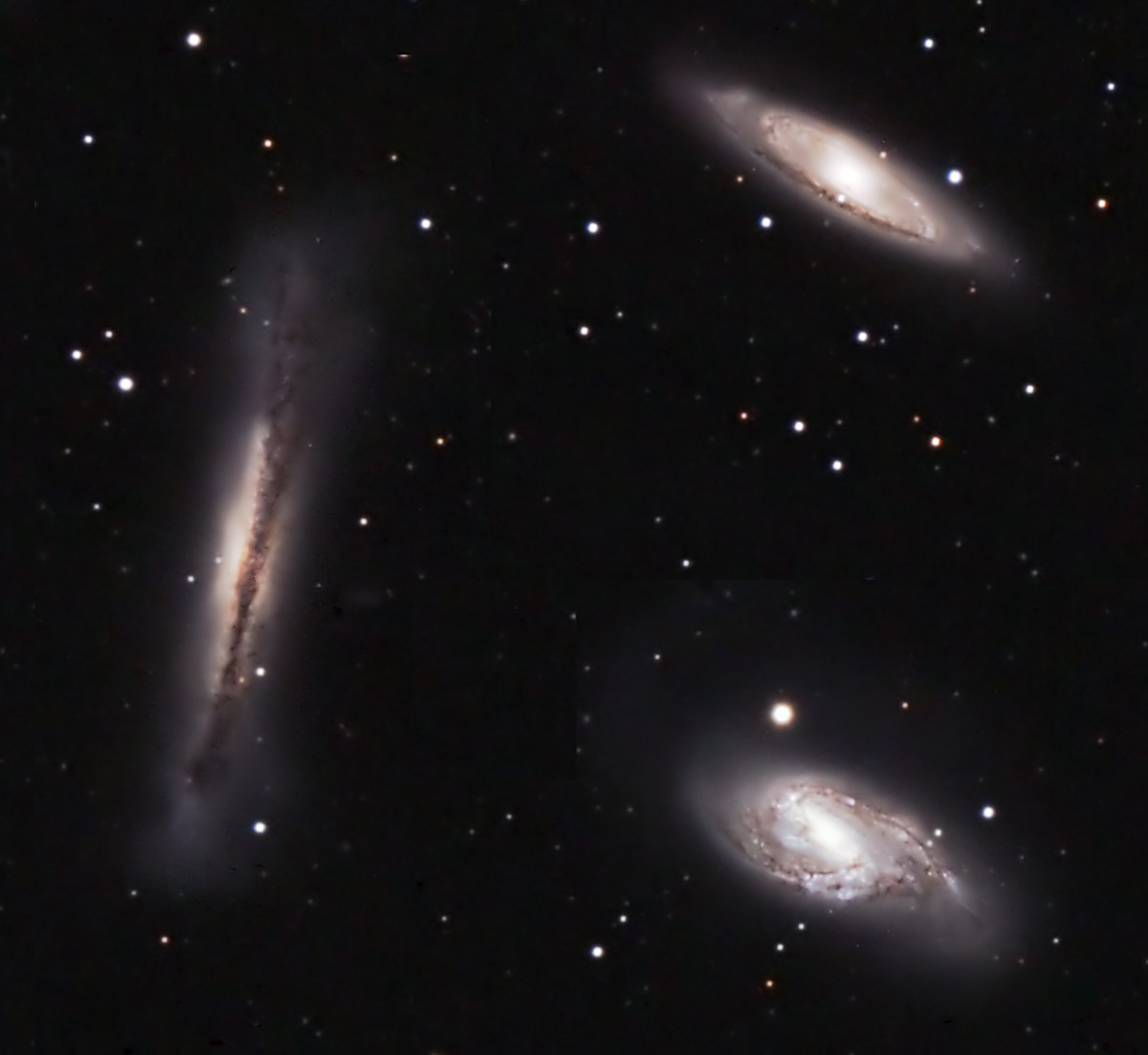
It is still “Galaxy Season” and we will be able to see them on our big screen in the scope room. The Pleiades, Double Cluster and Beehive open clusters will be available on our other scopes as well. There are several unique trio of galaxies that are right below the constellation of Leo (the lion). It is called the Leo Triplet and they are about 35 million light years away. We took this image during our Messier Marathon last weekend.
Be sure to check communityobservatory.com before you head up the hill. We call weather closures no later than 3 PM so, if you check it after 3 and we haven’t announced a closure, come on up. Even though we have had some warm days, our nights can be cold. Bring a jacket. Be prepared to pay $2 to the college for parking.


Comments
Post a Comment